HIRO – Human–Robot Interaction for Healthcare: From Testbed to Commercial Deployment

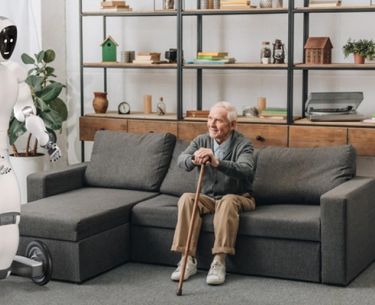
The HIRO (Human–Robot Interaction for Healthcare) project was established to explore how humanoid robots can contribute to improved healthcare services in both hospital and municipal settings. The project addressed a growing need for innovative solutions that can relieve healthcare professionals from repetitive and time-consuming tasks, improve workflow efficiency, and support patients in everyday activities. HIRO was organized as a multidisciplinary collaboration across healthcare, technology development, and research, with a strong emphasis on user involvement. A reference group and user panel were established at an early stage, and systematic needs assessments were conducted to identify tasks with potential for robotic assistance.
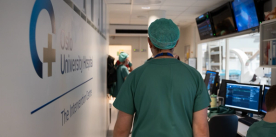
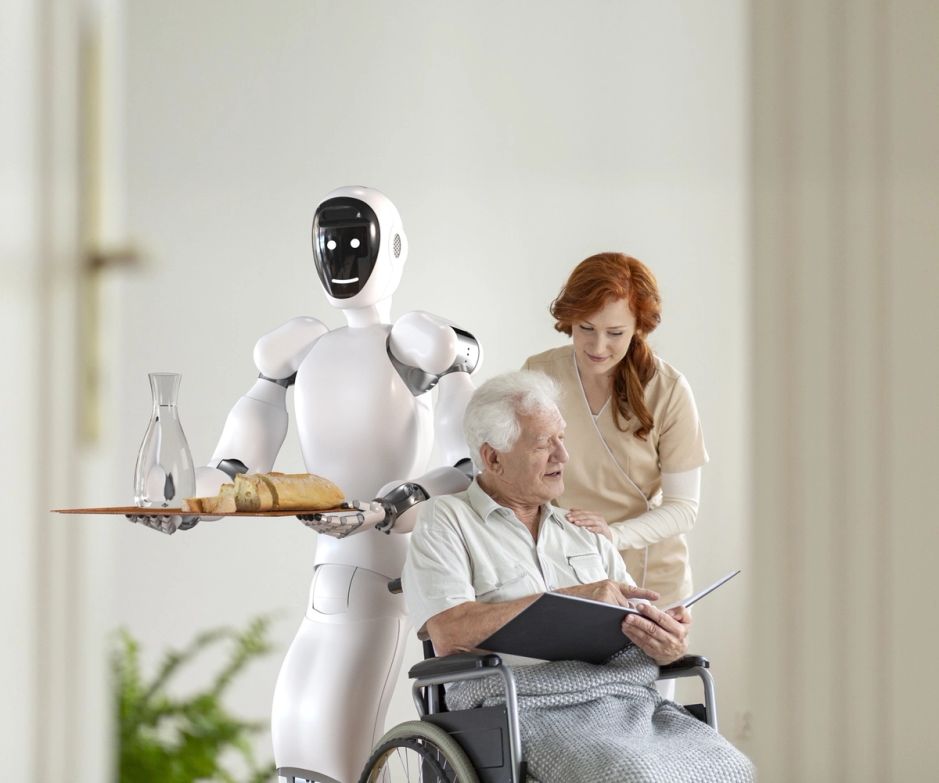
Sunnaas Sykehus served as a testbed in the project, providing real-world environments for testing the humanoid robot in practical assistance tasks. The robot was trialed as an assistant to healthcare staff and patients, including tasks such as fetching and delivering equipment, handing over medical items, guiding patients within facilities, and supporting individuals with functional impairments in simple daily activities. Testing in authentic clinical settings proved crucial for generating realistic feedback on usability, safety, and integration into existing workflows. As emphasized by Stein Erik Maurice, Chief Operating Officer at 1X Technology: “It was essential to test our robots in real-world environments during the development phase in order to obtain feedback that could inform further development.”

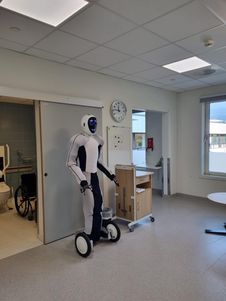
The project involved a broad consortium of partners, including Sunnaas Rehabilitation Hospital, Skien municipality, Institute for Energy Technology, and 1X Technology, alongside researchers, clinicians, patient representatives, and international experts in human–robot interaction, ethics, and innovation.
The collaboration was experienced as highly successful. Despite participants coming from different sectors and professional cultures, there was a shared openness and willingness to ask questions, clarify terminology, and learn from each other—an important prerequisite for meaningful interdisciplinary work.
The testing activities generated valuable new insights. Healthcare professionals reported that the robot could be a useful contribution for practical support tasks, provided that the solution is reliable, easy to use, and has a low error rate. Patients were generally positive toward receiving robotic assistance for practical tasks and often reflected on the robot as part of the overall rehabilitation offering rather than merely a technical tool. At the same time, patients clearly expressed boundaries regarding acceptable use, emphasizing that assistance with personal care should remain a human responsibility. The project also resulted in concrete recommendations for organizing robotic services in hospital and municipal contexts, including implementation requirements and training needs.
A key lesson learned was the importance of involving hospital IT and infrastructure partners at an early stage in such trials. During the project, challenges emerged related to network access and secure system integration, highlighting the need for early planning and coordination well in advance of testing. These experiences form an important basis for future projects and for others considering real-world testing of robotic technologies in healthcare.
HIRO has contributed to increased knowledge and technological maturity within the healthcare sector, as well as reduced technology skepticism through extensive dissemination and media coverage. The project has also played a role in the rapid development of the industrial partner. When the collaboration with 1X Technology began, the company had approximately 12 employees. Today, following strong investor interest, the company has grown to more than 500 employees. Commercial sales of their new robot NEO began in December, marking a significant transition from research and pilot testing to market
deployment. Together, these experiences demonstrate that humanoid robots have the potential to become an important future support for healthcare professionals and patients—provided that development, testing, and implementation are grounded in real-world contexts and close collaboration with end users.

Project related publications:
Kaarstad, M., Fernandes, A., Eitrheim, M., Reegård, K. (2023). What will it take to hire a robot? Views from health care personnel and managers in a rehabilitation hospital. (In prep.) Submitted to ESREL 2023.
Fernandes, A., Bloch, M., Kaarstad, M., Eitrheim, M., Reegård, K.. Sørensen, L., Gottchal, E.L., Maurice, S.E. (2021). Human Interactive Robotics for Healthcare: State of Practice Review. IFE/E2021/001. 978-82-7017-933-6
Eitrheim, M., Kaarstad, M., Sørensen, L., Berg, K. ( 2023 ). Workload of rehabilitation healthcare personnel when assisted by a robot. Proceedings of the 33rd European Safety and Reliability Conference, 2326 - 2333.
Fernandes, A., Reegård, K., Kaarstad, M., Eitrheim, M. & Bloch M. ( 2023 ). Humanoid Robots in Healthcare: Lessons Learned from an Innovation Project. in Proceedings of the 2023 32nd IEEE International Conference on Robot and Human Interactive Communication (RO-MAN), Busan, Korea, Republic of, 2023, pp. 429 - 434, doi: 10.1109/RO-MAN57019.2023.10309375.
Sørensen, L., Kaarstad, M., Eitrheim, M., Fernandes, A., Reegård, K. (2025). Humanoid Robots, A Future Health Care Service?. In: Palinko, O., et al. Social Robotics. ICSR + AI 2024. Lecture Notes in Computer Science(), vol 15562. Springer, Singapore. https://doi.org/10.1007/978-981-96-3519-1_2